The Secret Sisterhood That Navigated America's Bombers Across Starless Oceans
The Secret Sisterhood That Navigated America's Bombers Across Starless Oceans
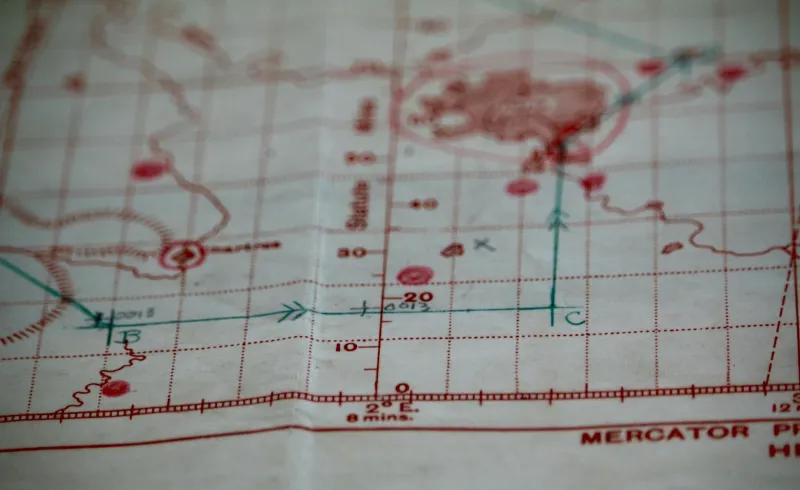
In 1943, somewhere over the Pacific Ocean, a B-24 Liberator bomber was hopelessly lost. Radio contact had failed, cloud cover obscured any landmarks, and the crew was running low on fuel with no idea which direction led to safety. What saved them wasn't advanced radar or secret military technology — it was a 23-year-old woman named Dorothy Harrison, sitting in a windowless room in Hawaii, using star charts and calculations that would have been familiar to ancient Polynesian navigators.
 Photo: Pacific Ocean, via images.hindustantimes.com
 Photo: B-24 Liberator, via m.media-amazon.com
Dorothy was part of a classified program so secret that most of the women involved didn't learn each other's real names until decades after the war ended. They were the celestial navigation specialists — a handpicked corps of mathematically gifted women who kept America's Pacific war effort on course using techniques that predated the compass.
The Women Who Learned to Read the Sky
The program began in 1942, when the Navy realized it had a navigation crisis. Flying missions across the vast Pacific meant traversing thousands of miles of empty ocean, often under radio silence, with no landmarks and frequently no visible stars due to cloud cover. Traditional navigation methods were failing at an alarming rate, and the military was losing planes not to enemy fire, but to simple disorientation.
The solution came from an unlikely source: Commander Grace Hopper (yes, that Grace Hopper, though this was years before her computer programming fame) had been studying Polynesian wayfinding techniques. She proposed training specialists who could provide real-time navigation support to aircraft using a combination of celestial observation, mathematical calculation, and educated guesswork based on weather patterns and ocean currents.
 Photo: Grace Hopper, via zahradkovo.eu
The catch was that the work required an unusual combination of skills: advanced mathematics, pattern recognition, spatial reasoning, and the ability to make split-second calculations under extreme pressure. After testing hundreds of candidates, the Navy discovered that young women with backgrounds in mathematics or astronomy consistently outperformed male candidates.
By late 1942, the first class of 30 women had been recruited and sworn to secrecy.
The Science of Finding Your Way in Nothing
What these women learned was part ancient art, part cutting-edge science. They studied traditional Polynesian navigation techniques — reading wave patterns, understanding how clouds form differently over islands versus open ocean, recognizing the subtle ways that bird flight patterns indicate nearby land.
But they also mastered advanced celestial mathematics. Each woman could calculate a plane's position using star sightings, determine drift caused by wind currents, and provide course corrections based on incomplete or contradictory information. They worked with specialized equipment that could track aircraft positions across thousands of miles of ocean, even when the planes themselves had no idea where they were.
The training was intense and comprehensive. Women learned to identify over 200 individual stars and their seasonal positions, memorize the mathematical formulas for calculating position based on celestial observations, and develop an intuitive understanding of Pacific weather patterns that took most meteorologists years to acquire.
Most remarkably, they learned to navigate by proxy — using radio communications to gather partial information from lost aircraft and piece together probable positions based on incomplete data.
The Invisible Network That Saved Thousands
By 1944, the celestial navigation program had expanded to include over 200 women working from stations across the Pacific. They operated from Hawaii, Guam, the Philippines, and Australia, maintaining 24-hour coverage that could provide navigation assistance to any Allied aircraft in the Pacific theater.
The women developed their own informal communication networks, sharing information about weather patterns, enemy activity, and navigation hazards across thousands of miles. They created coded language systems that allowed them to communicate sensitive information over potentially compromised radio channels.
Most importantly, they saved lives. Conservative estimates suggest that the celestial navigation specialists provided critical assistance to over 10,000 individual flights during the war. In many cases, their guidance was the difference between a successful mission and a plane lost at sea.
The work was demanding and often terrifying. The women knew that miscalculations could cost lives, and they frequently worked 16-hour shifts during critical operations. Many described the psychological pressure of guiding lost aircraft while knowing that fuel was running low and rescue options were limited.
The Polynesian Connection That Changed Everything
What made the program truly revolutionary was its integration of indigenous knowledge with modern technology. The women studied under traditional Polynesian navigators who taught them to read the ocean in ways that Western science had never formally documented.
They learned that certain wave patterns indicate the presence of distant islands, that cloud formations change subtly when influenced by land masses, and that the behavior of seabirds provides reliable information about direction and distance to shore.
This knowledge proved invaluable when working with aircraft that had lost electronic navigation equipment. A navigator could guide a plane toward probable land using techniques that required no instruments beyond careful observation and mathematical calculation.
The fusion of ancient wayfinding wisdom with modern aviation technology represented a remarkable example of cross-cultural knowledge transfer — though one that remained classified for decades after the war ended.
The Silence That Followed Victory
When the war ended in 1945, the celestial navigation program was quietly disbanded. The women were sworn to lifelong secrecy about their work and dispersed to civilian lives. Most were given generic commendations that mentioned "administrative support" or "communications work" — nothing that hinted at their actual contributions.
The advent of radar and satellite technology in the 1950s made celestial navigation seem obsolete, and the military had little interest in preserving institutional memory of techniques that appeared outdated. The women's detailed navigation logs, training materials, and operational records were classified and stored in archives where they remained largely forgotten.
Many of the women went on to careers in mathematics, astronomy, and early computer programming. Dorothy Harrison became one of the first female air traffic controllers. Several others worked on NASA's early space program, bringing their celestial navigation expertise to the challenge of guiding spacecraft.
But they couldn't talk about the work that had prepared them for these roles. For decades, their wartime service remained a secret they carried alone.
The Recognition That Came Too Late
It wasn't until the 1990s, when military records from World War II began being declassified, that historians started piecing together the story of the celestial navigation program. Even then, many details remained classified, and most of the women involved had died without ever receiving public recognition for their contributions.
The few surviving navigators who were eventually interviewed described a bittersweet mix of pride and frustration. They had been part of something remarkable — a program that saved thousands of lives and demonstrated the power of combining traditional knowledge with modern technology. But they had been forced to keep it secret for most of their lives.
Today, as GPS makes navigation seem effortless and automatic, it's worth remembering that there was a time when finding your way across the Pacific Ocean required human skill, mathematical precision, and the kind of intuitive understanding that could only come from years of studying the subtle patterns of sea and sky.
Somewhere in the declassified archives, there are detailed records of how a group of remarkable women mastered the art of navigation by starlight and saved thousands of lives in the process. Their story reminds us that some of the most important work happens in windowless rooms, performed by people whose names never make it into the history books — but whose skills make the difference between mission accomplished and mission lost forever.