The Week in 1927 That Accidentally Created American Music — In a Town Nobody Had Heard Of

There's a moment in music history so seismic, so absurdly consequential for such an unlikely location, that it almost sounds made up. In late July of 1927, a man named Ralph Peer drove a truck packed with recording equipment into a small mountain town straddling the Tennessee-Virginia state line. He was there for maybe six days. What he recorded in a converted warehouse on State Street changed American music forever.
That town was Bristol. You probably haven't been there. Most Americans haven't. But every time you've heard a country song, a bluegrass riff, or really any strand of American roots music, you've been listening to something that traces its commercial DNA back to that single week.
How a Furniture Store Warehouse Became Ground Zero
Ralph Peer worked for the Victor Talking Machine Company — one of the dominant record labels of the 1920s. He'd already made a name for himself recording regional and "race" music, meaning he understood before most of his colleagues that there was a market for sounds that didn't originate in New York or Chicago.
His instinct for Bristol was partly logistical. The town sat on a railroad junction, making it accessible from deep in the Appalachian hills. He placed ads in local newspapers promising musicians a chance to record, with the possibility of royalties. The response was overwhelming.
Peer set up his equipment in a hat warehouse on State Street — the actual state line between Tennessee and Virginia runs down the center of that street, which is its own strange footnote — and started auditioning whoever showed up.
What showed up changed everything.
The Carter Family Walked In Off a Dirt Road
A.P. Carter, his wife Sara, and his sister-in-law Maybelle drove in from Maces Spring, Virginia, a tiny community deep in Scott County. They were farm people. A.P. collected folk songs obsessively, traveling the hills to transcribe melodies from anyone who'd sing them. Sara had a voice that could stop a room. Maybelle played guitar in a way nobody else did — picking the melody on the bass strings while strumming the rhythm above it, a technique that would become so foundational it's now called the "Carter scratch."
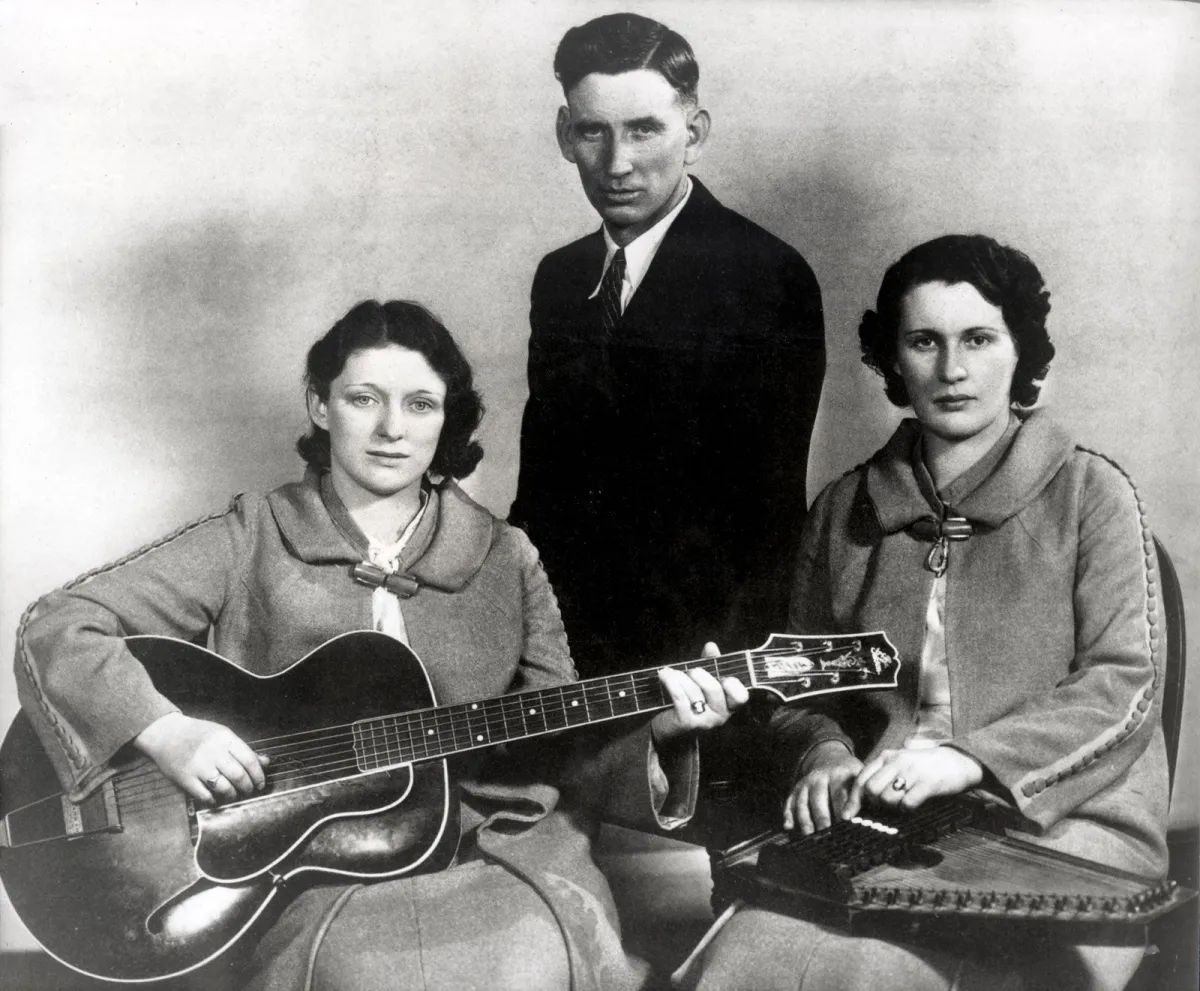 Photo: The Carter Family, via cdn.britannica.com
Peer recorded them. The songs they laid down — "Single Girl, Married Girl," "Bury Me Under the Weeping Willow" — weren't polished pop productions. They were something rawer and older, mountain harmonies that sounded like they'd been living in the hills for a hundred years. Because they had been.
The Carter Family became stars. Their recordings sold in numbers that stunned Victor. They went on to record hundreds of songs and became the template for virtually every family harmony act in country music history. June Carter Cash, of Johnny Cash fame, was Maybelle's daughter. The bloodline runs straight from that warehouse floor.
Then Jimmie Rodgers Showed Up
If the Carter Family represented the old mountain tradition, Jimmie Rodgers represented something new and restless. He'd worked the railroads, drifted through the South, absorbed blues and jazz and gospel and mashed them into something that had no name yet.
Peer almost passed on him. Rodgers showed up with a band that fell apart before the session, and he ended up recording solo, just voice and guitar. Peer took a chance. The result — a yodeling, blues-inflected, genre-defying style — became the foundation of what we'd eventually call country music's "singing cowboy" tradition. Rodgers became known as the Father of Country Music. He sold millions of records before tuberculosis killed him at 35.
Two acts. One warehouse. Six days. The math is staggering.
Why Bristol Gets Overlooked
Part of the reason Bristol faded from the popular imagination is geography. It's not Nashville. It's not Memphis. It's a mountain border town that most Americans drive past on I-81 without a second thought. The music industry's center of gravity moved to Nashville in the 1940s and 50s, and the story of where that industry actually started got absorbed into the broader Nashville mythology.
Music historians have long known the truth. The Smithsonian has called the Bristol Sessions the "Big Bang of country music." In 1998, Congress passed a resolution officially recognizing Bristol as the Birthplace of Country Music — a designation that got a lot less press than it deserved.
There's now a dedicated museum in Bristol, the Birthplace of Country Music Museum, which opened in 2014. It's genuinely excellent and genuinely undervisited.
What It Means That It Happened Here
There's something worth sitting with in the sheer accidental quality of all this. Ralph Peer wasn't trying to invent a genre. He was trying to find sellable regional music. The Carter Family wasn't trying to become icons. They were trying to make some money during a hard summer. Jimmie Rodgers wasn't trying to become the Father of Country Music. He was trying to catch a break.
None of them knew what they were making. That's often how the biggest things happen — not through grand design, but through a truck full of equipment, a newspaper ad, and a handful of musicians willing to drive down a dirt road on the chance that someone might want to hear what they'd been playing all their lives.
Bristol, Tennessee. Population around 27,000. Birthplace of American popular music. Look it up.