The Bell Labs Genius Who Built the First Computer on His Kitchen Table — And History Forgot His Name

In November 1937, a Bell Labs mathematician named George Stibitz sat at his kitchen table in New York, surrounded by flashlight bulbs, battery strips torn from tin cans, and wire. What he built that evening would become the foundation for every computer, smartphone, and digital device you've ever touched. Yet ask a dozen people who invented binary computing, and you'll get answers like "Alan Turing" or "maybe someone at IBM." George Stibitz's name won't come up.
 Photo: Bell Labs, via i.pinimg.com
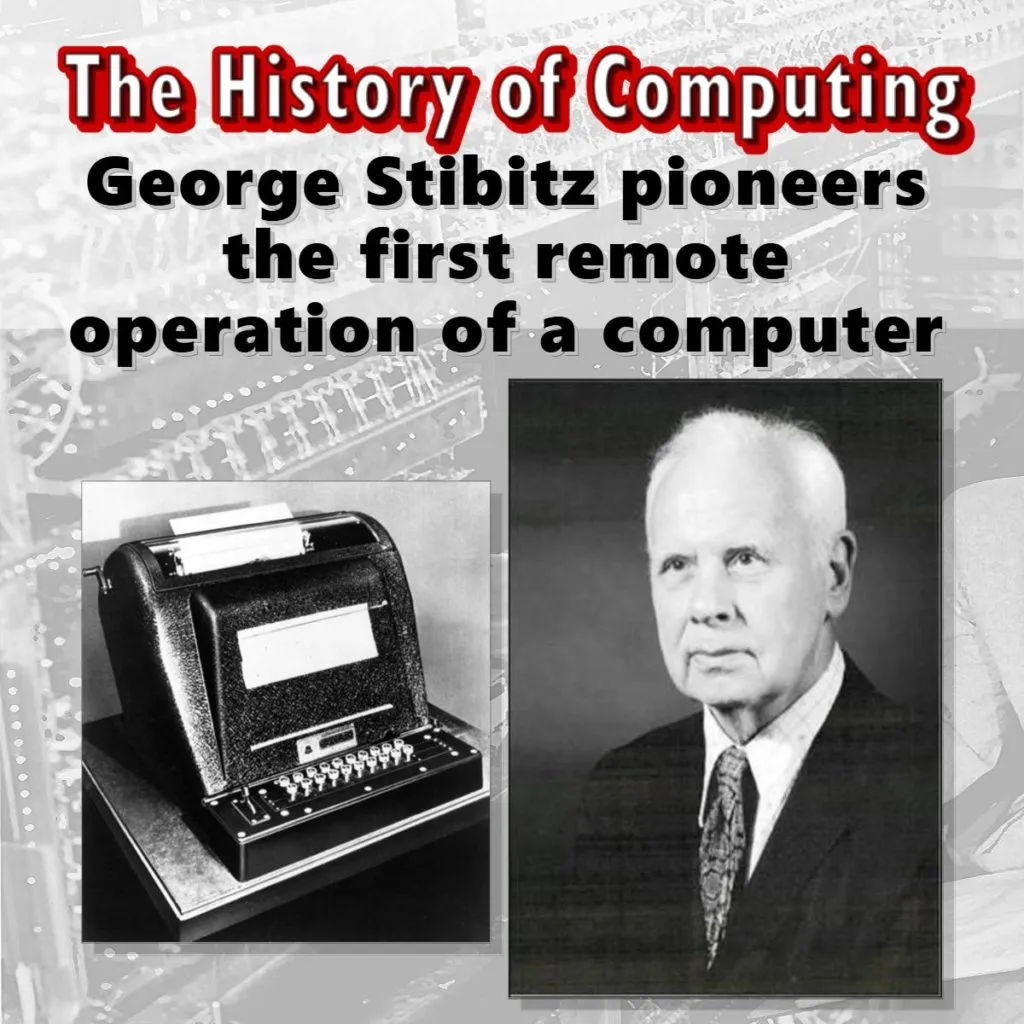 Photo: George Stibitz, via tinusaur.com
This is the story of how one man's weekend hobby project became the language computers speak — and how corporate timing and office politics buried his legacy so completely that even computer science textbooks barely mention him.
The Kitchen Table That Changed Everything
Stibitz wasn't trying to invent the future that November evening. He was just frustrated. As a mathematician at Bell Labs, he spent his days wrestling with complex relay circuits for telephone switching systems. The binary logic driving these systems — where electrical circuits were either "on" or "off" — struck him as remarkably similar to mathematical logic, where statements were either "true" or "false."
So he decided to build a simple adding machine.
Using two flashlight bulbs as output indicators, strips of metal from a tobacco tin as contacts, and a handful of telephone relays "borrowed" from work, Stibitz constructed what he called his "Model K" — K for "kitchen table." When he flipped switches representing binary numbers, the bulbs would light up to show the sum. He had just built the world's first binary calculator.
The demonstration was elegantly simple: flip switches to input "1" and "1" in binary, and a single bulb would light up, representing "10" (binary for the number 2). It was crude, loud, and took up half his dining table. It was also revolutionary.
From Kitchen Experiment to Corporate Breakthrough
Stibitz brought his contraption to Bell Labs the next day, expecting mild interest from colleagues. Instead, his supervisor immediately saw the potential. Within months, Bell Labs had funded development of a room-sized version called the Complex Number Calculator — later renamed the Bell Labs Model I.
By 1940, Stibitz had achieved something that sounds routine today but was pure science fiction at the time: he demonstrated remote computing. At a mathematics conference at Dartmouth College, he used a teletype machine to send calculation requests to his machine back in New York. The audience watched in stunned silence as complex mathematical problems were solved by a machine 250 miles away.
 Photo: Dartmouth College, via i.pinimg.com
John Mauchly and J. Presper Eckert — who would later be credited as pioneers of electronic computing — were in that audience. So was John von Neumann, the mathematician whose name became synonymous with computer architecture.
The Politics That Buried a Pioneer
Here's where Stibitz's story takes a frustrating turn. While his binary relay computers were solving critical military calculations during World War II, Bell Labs made a strategic decision that would cost him his place in history.
The company chose not to pursue electronic computing. Management believed mechanical relay systems were more reliable than the newfangled vacuum tubes other researchers were experimenting with. This wasn't entirely wrong — Stibitz's machines had impressive uptime compared to early electronic computers that failed constantly.
But it meant that when the war ended and computing exploded into public consciousness, Bell Labs had no electronic computer to showcase. The ENIAC at the University of Pennsylvania grabbed headlines. IBM's machines dominated business computing. Stibitz's relay computers, which had been doing sophisticated calculations since 1940, were suddenly seen as outdated.
Worse, Bell Labs was transitioning away from computing entirely, focusing instead on transistor development (where they would achieve massive success). The company had little interest in promoting its computing pioneers when it was pivoting to semiconductors.
The Man Who Spoke Computer Before Anyone Knew What That Meant
What makes Stibitz's erasure from history particularly tragic is how fundamentally his work shaped everything that came after. His binary arithmetic methods became standard across the industry. His remote computing demonstration anticipated the internet by decades. His approach to using electrical circuits for logical operations became the foundation of digital electronics.
Yet when computer science emerged as an academic discipline in the 1960s, textbooks focused on electronic computers and their inventors. Stibitz's mechanical relay machines were relegated to footnotes as "pre-electronic" computing — a historical curiosity rather than a foundational breakthrough.
Stibitz himself never fought for recognition. After leaving Bell Labs, he worked as a consultant and taught mathematics at Dartmouth College (the same school where he had demonstrated remote computing decades earlier). He published papers, mentored students, and watched the computing revolution unfold without him receiving credit for lighting the fuse.
The Legacy Hidden in Plain Sight
George Stibitz died in 1995, just as the internet was becoming mainstream and personal computers were in millions of homes. Every one of those devices operated on the binary principles he had worked out on his kitchen table in 1937.
His story reveals something uncomfortable about how we write technological history. We tend to celebrate the inventors whose work led to commercial success, not necessarily those whose ideas were most foundational. We remember the names associated with breakthrough products, not the researchers whose quiet innovations made those products possible.
Today, when we talk about the pioneers of computing, we mention Turing's theoretical work, von Neumann's architecture, and the ENIAC team's electronic breakthrough. All deserving of recognition. But we skip over the mathematician who first proved that electrical circuits could think in binary — the fundamental insight that makes all digital technology possible.
Somewhere in the history of Silicon Valley's origin story, there should be room for the man who built the first computer on his kitchen table, using flashlight bulbs and strips of tin. The fact that there isn't says more about corporate memory than it does about George Stibitz's contributions to the world you're navigating right now.