This Arizona Town Was Designed So Nobody Would Ever Need a Thermostat
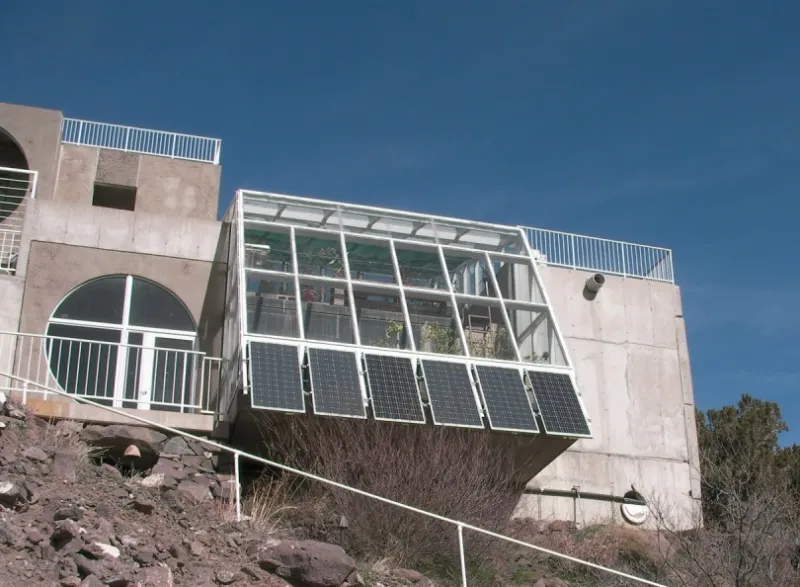
Photo: heather vescent, CC BY-SA 2.0, via Wikimedia Commons
There's a place in Arizona — about 70 miles north of Phoenix, out past the saguaro cacti and the red rock formations — where a small group of people live without conventional utility bills. Not because they're survivalists or doomsday preppers. Not because they're particularly wealthy or plugged into some government subsidy program. They live that way because the buildings themselves were designed to make it unnecessary.
Welcome to Arcosanti. It's one of the strangest, most fascinating, and most overlooked experiments in American urban design. And after five decades of being politely ignored by the mainstream, it's suddenly relevant again.
The Man With the Impossible Vision
To understand Arcosanti, you have to understand Paolo Soleri. Born in Turin, Italy in 1919, Soleri trained as an architect and came to the United States in the late 1940s to apprentice under Frank Lloyd Wright — already one of the most radical design thinkers in American history. But Soleri thought Wright wasn't thinking big enough.
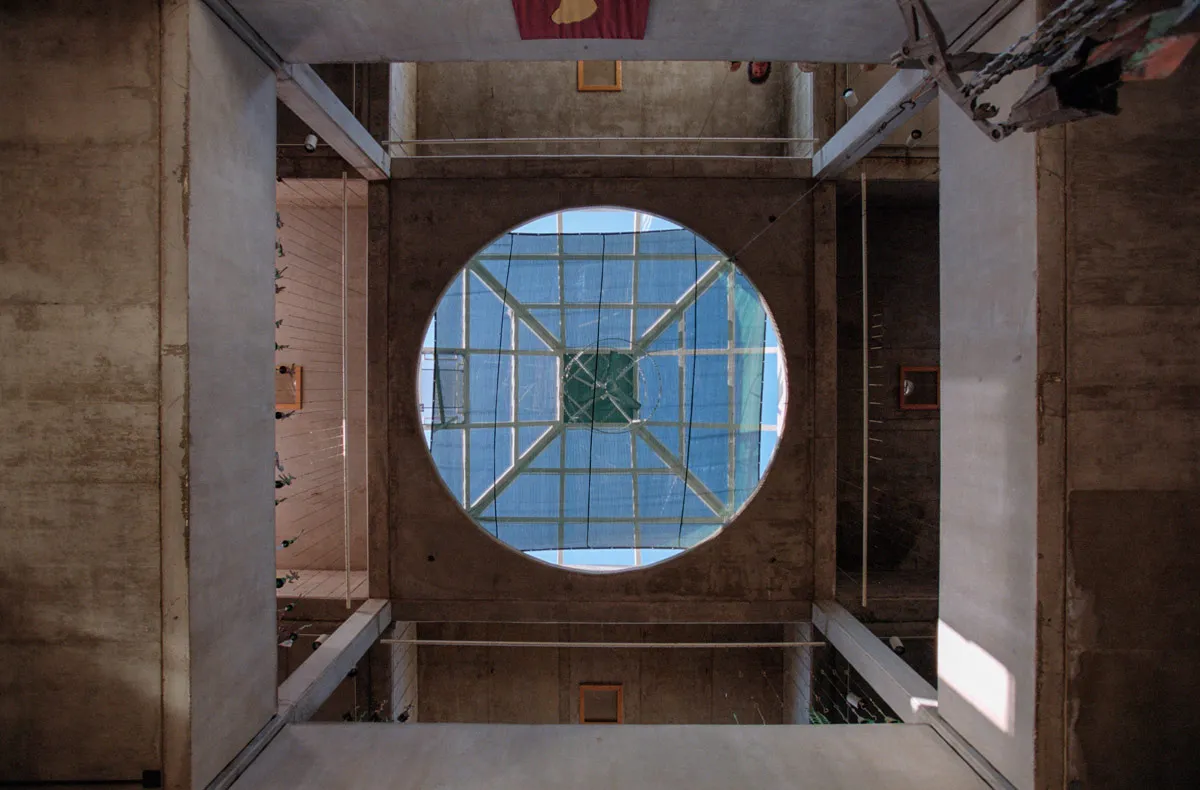 Photo: Paolo Soleri, via i0.wp.com
Soleri developed a philosophy he called arcology — a mashup of architecture and ecology. The core idea was almost shockingly simple: human settlements are inefficient because they spread outward, forcing people to consume massive amounts of energy just to move between places and maintain comfortable temperatures. What if, instead, you built upward and inward — compact, dense, interconnected structures where the design itself regulated temperature, reduced waste, and eliminated the need for cars?
In 1970, he put his money where his mouth was and broke ground on a patch of Arizona desert. The project was called Arcosanti, and Soleri spent the rest of his life — he died in 2013 — building it with the help of rotating crews of architecture students, volunteers, and true believers.
How the Buildings Actually Work
Here's the part that sounds like science fiction but is actually just smart physics.
Arcosanti's structures are designed around passive solar principles taken to an almost obsessive extreme. The iconic concrete apses — those enormous curved, south-facing vaults that look like something from a different planet — are positioned to capture low winter sunlight and drive it deep into living spaces. In summer, when the sun is higher in the sky, the same geometry keeps the interior in shade. No furnace. No air conditioner. The building does the work.
The thermal mass of the thick concrete walls absorbs heat during the day and releases it slowly at night, keeping interior temperatures remarkably stable year-round. In a climate where Phoenix summers routinely top 110°F and winter nights can dip below freezing, Arcosanti's residents experience something closer to a perpetual 68 degrees inside — without flipping a single switch.
Soleri also designed the community to eliminate car dependency entirely. Everything a resident needs on a daily basis is within walking distance, reducing energy consumption not just in the buildings but in the transportation system surrounding them.
The Utopia That Never Quite Finished
Here's the honest part: Arcosanti was supposed to house 5,000 people. Today, somewhere between 50 and 100 people live there full-time, and the construction is still, technically, ongoing. For decades, critics used this gap between vision and reality to dismiss the whole project as a beautiful failure — an architect's ego trip that never delivered.
But that framing misses the point. Arcosanti was never really about becoming a city. It was always about proving that the ideas worked. And on that front, it has delivered consistently for over 50 years.
The community funds itself partly through tourism — about 40,000 visitors show up every year to take tours and stay in the on-site accommodations — and through the sale of handcast bronze and ceramic wind bells that have become something of a cult object among design enthusiasts. It's a quirky, self-sustaining operation that has outlasted the skeptics by simply continuing to exist.
Why Urban Planners Are Suddenly Paying Attention Again
For most of Arcosanti's life, mainstream architecture treated it as a charming curiosity. Then something shifted.
As energy costs climbed, climate change moved from theoretical to urgent, and the concept of sustainable urban design moved from fringe to front page, Arcosanti's 50-year-old blueprints started looking less like hippie idealism and more like a working prototype. Several principles Soleri pioneered — passive solar orientation, thermal mass construction, walkable density — are now standard language in green building certification programs like LEED.
Young architects and urban planners who visit Arcosanti today tend to leave with the same unsettled feeling: that someone figured a lot of this out in 1970, and the mainstream just wasn't ready to listen. The community has hosted academic conferences, partnered with architecture schools, and quietly influenced a generation of designers who never even realized where the ideas came from.
You Can Actually Go There
One of the best things about Arcosanti is that it's not a museum or a historical site. It's a living place, and it's open to visitors. You can book a room, take a guided tour, eat at the café, and watch craftspeople casting the famous wind bells by hand. It's about a 90-minute drive from Phoenix, and it's the kind of experience that's genuinely hard to describe to people who haven't seen it.
Standing inside one of those curved concrete vaults on a July afternoon, feeling the temperature drop as you step out of the sun, you get a visceral sense of what Soleri was after. The building isn't fighting the desert. It's working with it.
In an era when Americans are paying record utility bills and cities are scrambling to figure out how to survive increasingly brutal summers, that feels less like a forgotten experiment and more like something we probably should have scaled up a long time ago.