The Grease-Stained Genius Who Figured Out Why Clunky Old Typewriters Made You a Better Writer
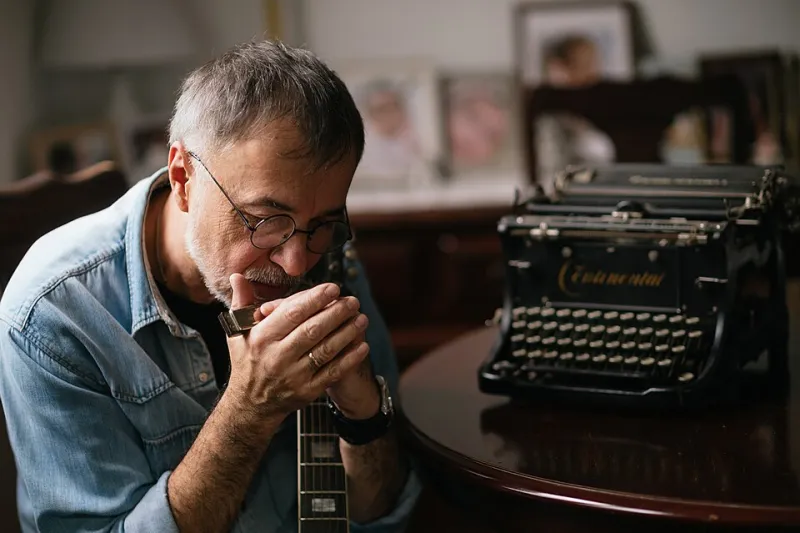
Photo: Shixart1985, CC BY 2.0, via Wikimedia Commons
Somewhere in a strip mall in Akron, Ohio, circa 1978, a man named Gerald Houser was elbow-deep in a disassembled IBM Selectric when he noticed something strange. His customers — the ones who came in asking him to make their machines lighter, faster, more effortless — were the same customers who came back complaining they couldn't focus. The ones who left with machines he'd deliberately left heavier? They seemed fine.
Houser wasn't a scientist. He was a typewriter repairman. But he was paying attention.
A Repair Shop Observation That Got Way Ahead of Its Time
During the 1970s and early '80s, the typewriter repair business was a surprisingly intimate trade. Technicians like Houser didn't just fix machines — they knew their customers. Secretaries, journalists, novelists, professors. People whose entire professional lives ran through their fingertips. And those technicians started noticing patterns that no academic study had yet bothered to measure.
Machines with heavier key resistance — older models, or those tuned to require more deliberate force — seemed to produce something different in the people who used them. Fewer corrections. Longer uninterrupted sessions. Writers who described feeling "locked in" to what they were doing in a way that the newer, silkier models didn't seem to replicate.
Word spread quietly through the repair community. Not in journals or trade publications, but in the way useful knowledge actually travels: shop to shop, over bad coffee at regional service conferences, scrawled in the margins of parts catalogs. Some technicians started tuning machines specifically to preserve that resistance. A few even built reputations around it.
Nobody called it anything. There was no framework for it yet. But they were describing what we'd now recognize as a tactile feedback loop — the way physical resistance from a task can anchor your attention to it.
What Neuroscience Eventually Caught Up To
Fast-forward about forty years, and researchers studying focus, motor learning, and what's sometimes called "embodied cognition" have started producing findings that would have made Gerald Houser nod slowly and say yeah, obviously.
The basic idea is this: when your body has to work slightly harder to perform a task, your brain allocates more attentional resources to it. The effort isn't wasted — it's signal. It tells your nervous system that this activity matters, that it requires presence. A keyboard that offers no resistance, no mechanical consequence, no physical accountability for each keystroke? It's frictionless in a way that, paradoxically, makes sustained thought harder.
Researchers at the University of Washington and elsewhere have explored how handwriting activates different neural pathways than typing on modern keyboards — pathways associated with memory encoding and creative synthesis. The typewriter technicians weren't studying neuroscience, but they were observing the same underlying phenomenon playing out in real time, with real people, across thousands of working hours.
The difference between a vintage manual typewriter and a modern membrane keyboard isn't just aesthetic. It's a completely different physical conversation between your hands and your thoughts.
The Quiet Revival Nobody Expected
Here's where it gets interesting for anyone who thought this was purely a history lesson.
Over the past decade, something unexpected has been happening in writing communities, university dorms, and independent coffee shops across the country. Manual typewriters — clunky, loud, ink-ribbon-requiring relics — have been selling. Not as decorations. As working tools.
Auctions for vintage Royals and Hermes 3000s regularly pull prices that would have seemed absurd twenty years ago. Authors like Tom Hanks and David McCullough have talked openly about writing on typewriters. But beyond the celebrity angle, a more practical undercurrent is driving the trend: people are genuinely reporting that they work better on them.
Students say they retain more of what they type. Programmers who use mechanical keyboards — the high-resistance, click-heavy kind that approximate the old typewriter feel — describe longer focus sessions. Writers say the permanence of each keystroke (no easy backspace, no autocorrect safety net) changes how they construct sentences before they commit to them.
That last part is something the old repair technicians talked about too. The machine made you think before you typed. Not because it was slow, but because each key press cost something.
The Lesson That Got Lost in the Upgrade Cycle
There's a particular kind of knowledge that lives in trades and crafts — knowledge that never makes it into academic literature because the people who hold it don't have institutional affiliations. Typewriter technicians were among the last practitioners of a physical, mechanical interface between humans and written language. When the industry collapsed in the mid-'80s under the weight of the personal computer revolution, that knowledge largely dissolved with it.
What's remarkable is that the insight didn't come from a lab. It came from watching people. From paying attention to which customers came back frustrated and which ones came back thriving. From being curious about something that wasn't, strictly speaking, your job to wonder about.
Gerald Houser retired sometime around 1991, which is about when you'd expect. His shop — like hundreds of others — closed quietly. But the thing he noticed? It's still true. The machines just look different now.
If you've ever wondered why your fanciest, lightest, most ergonomically optimized keyboard still somehow makes it hard to finish a thought — you might already know the answer. You just haven't had a repairman around to tell you.