She Ran the Family Finances With a Color-Coded Ledger — Then a Bank Exec Turned It Into 'Modern Accounting'
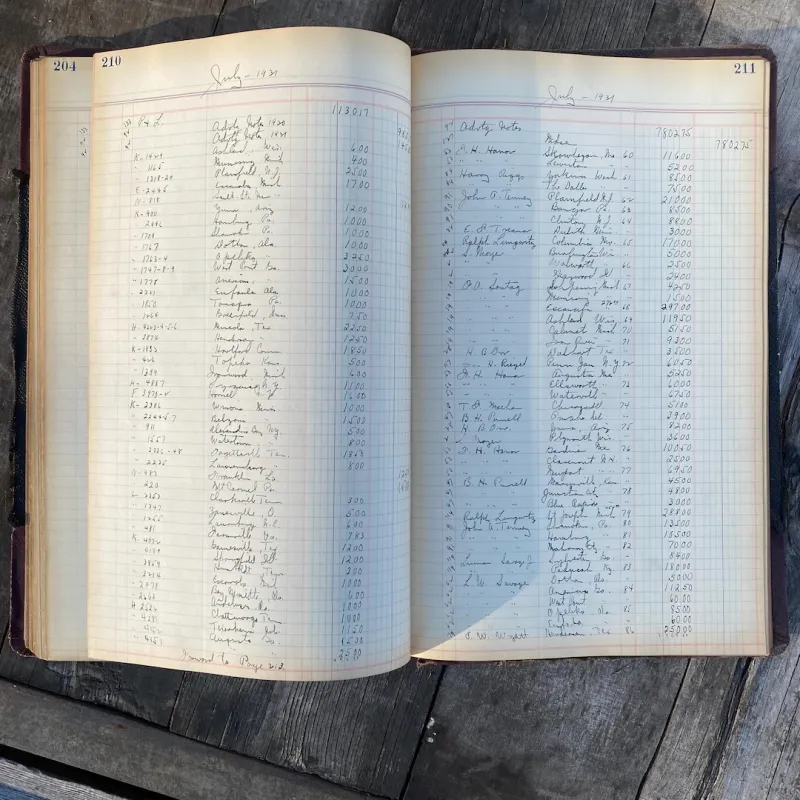
Photo: vintage handwritten ledger book financial records women 1920s, via i.etsystatic.com
Pick up almost any early-20th-century household management guide and flip past the canning recipes and curtain-laundering instructions. Somewhere in the back third, you'll usually find it: a chapter on household accounts. Not budgeting in the vague, aspirational sense. Actual systematic financial tracking — categories, running totals, surplus calculations, projected shortfalls.
This wasn't incidental advice. For millions of American women managing households between roughly 1890 and 1950, meticulous financial recordkeeping wasn't a hobby. It was survival infrastructure.
And it looked, in ways that should make any accountant pause, remarkably like modern bookkeeping.
The Ledger on the Kitchen Counter
The system that kept appearing across women's household guides — and in the actual surviving ledgers now held in historical archives from Massachusetts to Oregon — had a few consistent features that distinguished it from casual note-taking.
First: categorical separation. Household spending was divided into discrete buckets — food, fuel, clothing, medicine, education, savings — tracked independently so that overruns in one area didn't invisibly drain another. Second: color coding. Different ink colors (or, in more modest households, different pencil pressures and notations) flagged different types of transactions. Third: the running total with projected balance. Women weren't just recording what had been spent — they were forecasting what would be needed, accounting for seasonal variation, irregular income, and anticipated expenses months in advance.
This is, recognizably, budgetary accounting. Not a primitive version of it. A functional, sophisticated version of it.
The writer and home economist Christine Frederick, whose 1913 book Household Engineering brought industrial efficiency principles into domestic life, documented these systems in detail. But Frederick was building on practices already widespread among working-class and middle-class women who had developed them out of necessity, not theory.
Where the Credit Went
Here's the uncomfortable part of this story.
During the 1910s and 1920s, as American business culture began formalizing its own financial practices, a number of the categorical and tracking methods that became standard in corporate bookkeeping bore a striking resemblance to the domestic systems women had been using for decades. The timeline matters: household ledger practices were documented and widespread before many of the business accounting standardizations that are now treated as innovations of the corporate world.
Business historians have largely overlooked this overlap, in part because the sources don't align neatly. Corporate accounting has a paper trail of men with titles. Domestic accounting has a paper trail of women without them — their ledgers catalogued in historical societies under headings like "household papers" or "family documents," rarely indexed under anything that would catch a financial historian's eye.
The knowledge transfer wasn't always cynical or deliberate. Sometimes it was simply invisible. A bank executive's wife kept the household books. His secretary had learned organizational systems at home before she ever sat at an office desk. The methods moved through the culture without attribution because the labor that produced them was categorized as domestic, and domestic labor was not considered a source of intellectual innovation.
The Women Who Systematized It
Some names do survive, though they rarely appear in accounting textbooks.
Ella Morris Kretschmer, a home economics educator working in the Midwest in the 1910s, developed a household accounting curriculum that introduced categorical ledger systems to thousands of women through extension programs. Her materials — now sitting in university archives — show tracking methodologies that predate similar corporate practices by years.
The broader home economics movement, often dismissed as the institutionalization of women's domestic subordination, was simultaneously one of the largest applied science programs in American history. Women were being trained in systematic observation, measurement, record-keeping, and analysis. That the outputs of that training were categorized as "household management" rather than "financial science" is a classification problem, not an accuracy problem.
Why It Matters Now
Open any personal finance app on your phone — YNAB, Mint, Copilot, whatever you're using — and look at how it works. Categorical spending buckets. Color-coded dashboards. Running projections against anticipated income. A visual separation between different types of financial activity so you can see where imbalances are developing before they become crises.
You are using, in a touchscreen interface, a system that women in 1910 were running in pencil on ruled paper.
The lineage isn't direct in a way you can trace through a clean citation chain. But the logic is identical, because the problem is identical: how do you track complex, multi-category financial flows across time, in a way that lets you make better decisions with incomplete information and irregular income?
Women solved that problem under conditions of significant constraint — no formal training, no professional recognition, no salary for the work. They solved it because they had to. And then, as tends to happen with solutions developed by people without institutional power, the solution got picked up, formalized, and credited elsewhere.
The ledger didn't disappear. It just got rebranded.
Somewhere in a historical society archive, in a box labeled with a woman's name you've never heard, there's a color-coded household ledger from 1922 that looks almost exactly like the accounting software your company paid six figures for last year. The only thing missing is the patent.