The Mountain Hollow That Quietly Invented the American Pickle — Long Before Brooklyn Got Credit
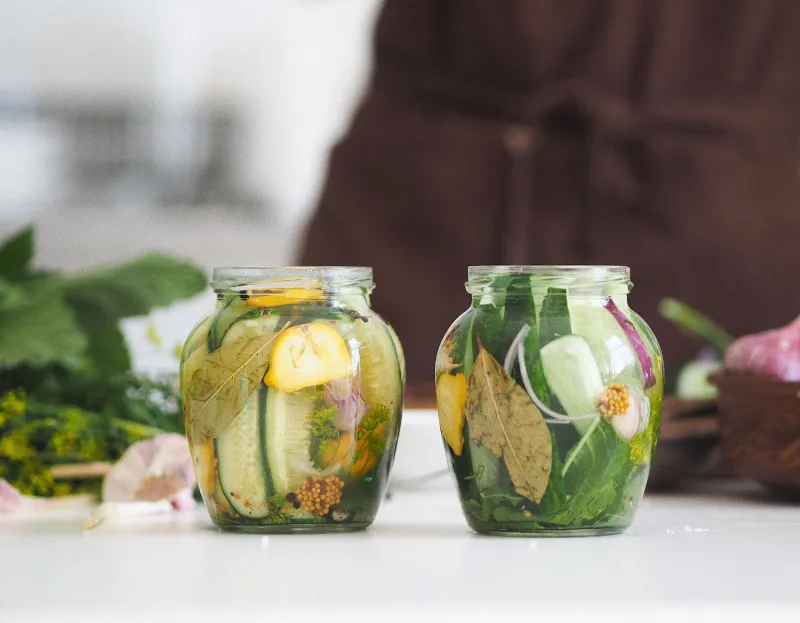
Walk into a specialty food market almost anywhere in America right now and you'll find a wall of artisan pickles. Bread-and-butter spears. Fermented half-sours. Dill brines infused with smoked garlic or dried chiles. Little hand-lettered labels explaining the "traditional" techniques behind each jar.
What those labels almost never mention is Appalachia.
Because somewhere in the fog of foodie mythology, the story of American fermentation got relocated to Brooklyn, Portland, and the farmers' market circuit — when the actual roots of the craft run deep into mountain hollows where families were doing this, with startling sophistication, long before Mason jars had brand recognition.
The Confluence Nobody Documented
To understand what happened in the southern Appalachian highlands, you have to understand who settled there and why their knowledge systems collided in such an unusual way.
German-speaking immigrants — Pennsylvanian Dutch communities, Moravians, and a scattering of independent farmsteaders — pushed into the mountain valleys of western Virginia, western North Carolina, and eastern Tennessee throughout the 18th century. They brought with them a serious fermentation culture: sauerkraut traditions, vinegar-brined root vegetables, and an instinctive understanding of lacto-fermentation that had been refined in central European kitchens for centuries.
What they encountered in those mountains was a Cherokee preservation tradition that operated on entirely different principles but arrived at surprisingly compatible outcomes. Cherokee communities had long used wild ramps, spicebush berries, and specific mineral-rich spring waters to cure and preserve foods. The brine chemistry was different. The flavor profiles were different. But the underlying logic — controlling microbial environments to extend the life of vegetables through winter — was the same.
Over several generations, these traditions didn't so much merge as layer. German settler families in communities like Watauga County, North Carolina, and the hollows around Grayson County, Virginia, began incorporating local wild ingredients into their brine formulas. Cherokee women, some of whom had married into German settler families by the early 1800s, contributed knowledge about which native plants functioned as natural preservatives. The result was something genuinely new: a regional fermentation style that existed nowhere else.
The Families Behind the Jars
Food historian Ronni Lundy, whose decades of work documenting Appalachian foodways have made her one of the few serious chroniclers of this tradition, has traced specific brine techniques to a handful of family lineages that kept the knowledge alive largely through oral transmission.
The Trivett and Greer families of Ashe County, North Carolina, are among those whose pickling practices have been partially documented. Neighbors and relatives recall cellars lined with stoneware crocks containing pickled beans — "leather britches" in local parlance — alongside brined cucumbers and fermented corn relishes that bore almost no resemblance to the vinegar-forward pickles that came to dominate commercial American production.
The key distinction was salt concentration and time. Commercial pickle production, which industrialized rapidly in the late 19th century, leaned heavily on vinegar as a fast preservative. The Appalachian tradition favored slower, salt-driven lacto-fermentation — the same biological process that produces the sour, complex, gut-friendly pickles that contemporary fermentation enthusiasts now pay premium prices for.
These families weren't doing it for gut health. They were doing it because it worked, it was cheap, and the flavor was better than anything a vinegar shortcut produced.
The Wild Ingredient Nobody Else Was Using
What makes the Appalachian tradition particularly distinctive — and what food scientists find genuinely interesting — is the incorporation of local wild ingredients that altered the microbial environment of the brine in ways that standard recipes couldn't replicate.
Spicebush berries (Lindera benzoin), a native Appalachian shrub, were added to some brine formulas in small quantities. Spicebush has measurable antimicrobial properties, and its aromatic compounds interact with fermenting vegetables in ways that subtly influence both flavor and preservation stability. Wild ramps contributed sulfur compounds. Certain spring waters in the region — naturally high in calcium and magnesium — created mineral profiles that supported specific lactobacillus strains and suppressed others.
The result was a fermented pickle with a flavor complexity that professional fermenters are now trying to reverse-engineer. Several chefs who rose to prominence in the 2010s fermentation revival — including some associated with acclaimed Southern restaurants — have quietly acknowledged that their early experiments were inspired by jars they encountered at Appalachian farm stands or in the kitchens of older relatives, not by any culinary school curriculum.
The Documentation Gap
Here's the uncomfortable part of this story: most of this knowledge came terrifyingly close to disappearing entirely.
The economic disruptions of the 20th century hit Appalachian communities hard. As younger generations left for industrial jobs in Midwestern cities and as commercially produced food became accessible even in remote mountain areas, the motivation to maintain labor-intensive fermentation traditions faded. By the 1970s, many of the families who had kept these techniques alive were elderly, and the knowledge lived primarily in their hands and memories rather than in any written record.
A small group of Appalachian food preservationists — working mostly outside academic institutions, mostly without funding — spent the 1980s and 1990s doing informal documentation. They visited elderly farmers, recorded oral histories, and collected handwritten recipe fragments. Their work has never been widely published, but it forms the foundation of what food historians are now calling a surprisingly rich and underappreciated American fermentation tradition.
What the Pickle Aisle Owes the Hollow
The next time you pick up a jar of small-batch, lacto-fermented half-sours at your local grocery store, the story on the label will probably mention something about European tradition or old-world technique. It might reference a chef's grandmother or a summer spent in a Scandinavian kitchen.
What it almost certainly won't mention is a stone crock in a North Carolina cellar, or the Cherokee knowledge of spicebush, or the German settlers who learned to listen to the mountain they'd moved to.
Those jars owe something to those hollows. The least we can do is know the story.