Grandma's Canning Cellar Was Actually a Science Lab — She Just Didn't Know It
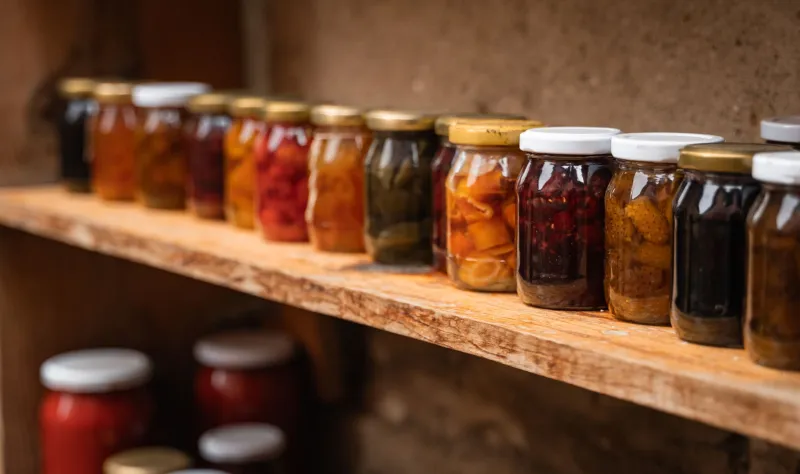
Somewhere around 1850, a farmwife in rural Ohio figured out that if she added a splash of vinegar to her green bean jars, they kept longer and tasted better. She didn't know why. She told her neighbor, who told hers, and the knowledge spread across the region through the invisible network of women who kept American households fed through long winters. It would be another fifty years before a scientist in a university laboratory explained the chemistry behind what she'd stumbled onto.
That gap — between the practice and the explanation — is the whole story.
What They Were Actually Doing
Home canning as a widespread American practice exploded after John Mason patented his famous jar in 1858. But the technique of preserving food through heat and sealed containers predated Mason's jar, and the women who practiced it were, without formal training or scientific vocabulary, conducting genuine microbiology experiments every time they fired up the stove.
Consider what a successful canning operation actually requires. You need to understand — even intuitively — that heat kills spoilage organisms, that acidity creates a hostile environment for bacteria, that oxygen is your enemy, and that the seal between your jar and the outside world has to be absolute. Get any of those variables wrong and your family gets sick. Get them right consistently, across seasons and ingredient variations, and you've demonstrated a working mastery of applied food microbiology.
These women had no textbooks. What they had was observation, experimentation, and a ruthless quality-control system: anything that smelled wrong, looked wrong, or caused illness got noted and corrected. Over generations, this produced a body of practical knowledge that was, by any honest measure, sophisticated.
The Acid Question
One of the most striking examples involves the role of acidity in preservation — what food scientists now describe in terms of pH control.
Women canning tomatoes, pickles, and fruit preserves were working with naturally acidic foods, and they learned early that these products were more forgiving and longer-lasting than low-acid vegetables like corn or green beans. They didn't know about Clostridium botulinum, the bacterium responsible for botulism, which thrives in low-acid, oxygen-free environments. But they knew, empirically, that certain foods needed to be treated differently — that you could water-bath a jar of tomatoes but that green beans needed something more.
The "something more" they often reached for was exactly right: longer processing times, added acid (vinegar), or in some traditions, pressure cooking using weighted lids and sealed pots that were crude but functional precursors to the modern pressure canner. They arrived at these solutions not through theory but through the grim feedback loop of what happened when they got it wrong.
The Scientists Who Finally Listened
Formal food science didn't really engage with home canning knowledge until the early twentieth century, and even then, the engagement was often condescending — male researchers studying "women's work" with an air of correcting folk superstition rather than documenting legitimate expertise.
But a handful of women scientists pushed back on that framing. Figures like Mary Engle Pennington, a bacteriologist who worked with the USDA in the early 1900s on food refrigeration and preservation, approached the existing body of home knowledge as a starting point rather than a problem to be solved from scratch. Her work on food safety — much of it focused on understanding what ordinary households were already doing correctly — helped bridge the gap between kitchen practice and laboratory science.
Later, the USDA's cooperative extension program, which sent home economists into rural communities starting in the 1910s, produced a fascinating two-way exchange. Yes, the extension agents were teaching updated methods. But they were also systematically documenting regional variations in canning practice, many of which turned out to encode genuinely valuable insights that hadn't yet been formalized in scientific literature.
Fermentation: The Chapter That Got Buried
Beyond canning, the home fermentation traditions of the 1800s represent another layer of unrecognized food science. Sauerkraut, pickled vegetables, salt-cured meats, sourdough starters — all of these involve managing microbial communities with considerable precision.
A woman maintaining a sourdough starter over decades was, in effect, selectively cultivating a specific ecosystem of wild yeasts and bacteria, keeping the culture fed, temperature-stable, and free from contamination. Modern microbiologists who study historic sourdough cultures have found that some of the oldest continuously maintained starters contain microbial strains that have since become rare or regionally specific — a kind of accidental biodiversity preservation that nobody planned.
The fermentation revival of the last decade — the kimchi crocks on Brooklyn countertops, the kombucha brewers, the natural wine enthusiasts — is often framed as a cutting-edge food movement. What it's actually doing is rediscovering a knowledge base that American women maintained for generations and that the twentieth century's processed food industry nearly erased.
What We Almost Lost — And What's Coming Back
The midcentury shift toward canned and frozen commercial food wasn't just a convenience story. It was a knowledge-transfer failure. When families stopped canning at home, the practical understanding of why the techniques worked — not just that they worked — began to dissolve within a generation or two.
What's interesting now is that the rediscovery is happening on two tracks simultaneously. Food scientists are publishing peer-reviewed research on fermentation chemistry that would have been completely recognizable to a farmwife in 1880, even if the vocabulary is different. And home fermenters and canners are rebuilding practical knowledge communities online, passing down techniques through YouTube videos and Reddit threads in a way that structurally mirrors the neighbor-to-neighbor networks of the nineteenth century.
The science was always there. It just took us a while to admit who figured it out first.