The Secret Weapon Hidden in the Library: How a Group of Women Card-Catalogued America to Victory in WWII
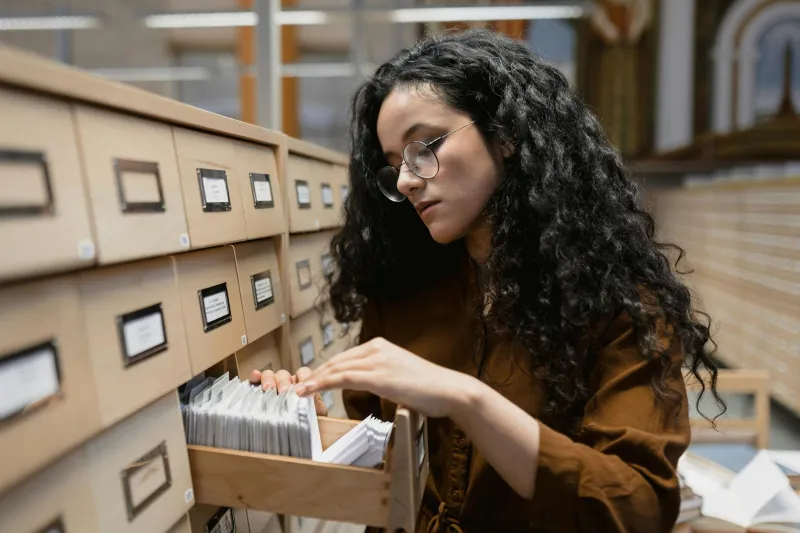
The Secret Weapon Hidden in the Library: How a Group of Women Card-Catalogued America to Victory in WWII
When people talk about the intelligence operations that helped the Allies win World War II, the conversation usually goes to codebreakers at Bletchley Park, double agents running circles around the Gestapo, or the dramatic cloak-and-dagger work of the OSS field operatives. What almost nobody talks about is the card catalog.
Which is a shame, because the card catalog might have mattered more than any of it.
The Problem Nobody Wanted to Solve
By 1942, the newly formed Office of Strategic Services — America's wartime intelligence agency, the precursor to the CIA — had a problem that sounds almost mundane compared to the drama of espionage: they were drowning in paper.
Field reports, intercepted communications, newspaper clippings from occupied Europe, academic research on foreign geography and infrastructure, translated documents from a dozen different countries — information was pouring in faster than anyone could process it. Analysts would spend days trying to locate a single piece of intelligence they knew existed somewhere in the archive. Critical connections between pieces of information went unnoticed simply because nobody could find both pieces at the same time.
The OSS needed a system. And they knew exactly where to find people who understood systems.
They hired librarians.
Building the Index That Won the War
The Central Information Division of the OSS was staffed largely by women — professional librarians and archivists recruited specifically because they understood how to organize, classify, and retrieve information at scale. In a moment when female professionals were routinely underutilized in the war effort, the OSS made a surprisingly pragmatic decision: they put the most qualified people in the room, regardless of gender, and gave them a genuinely hard problem to solve.
What these women built was remarkable. They developed a cross-referencing index system that could connect a field report from a French partisan with a prewar railway survey, a translated German military memo, and a geography paper from a Harvard professor — and surface all four documents in response to a single analyst query. They created subject taxonomies that didn't exist before, inventing classification systems for types of information that had never needed to be classified systematically.
The work was painstaking, unglamorous, and absolutely essential. When an OSS analyst needed to know the load capacity of a specific bridge in northern Italy, or the location of fuel depots in a German-occupied region, or the name of a local official who had shown sympathy to Allied interests — the answer came from the index. And the index worked because the women who built it understood that information is only as useful as your ability to find it.
The Names History Forgot
Here's where the story gets genuinely frustrating.
The men who ran the OSS — William Donovan, the agency's famous director, and his circle of well-connected lawyers and academics — are well-documented figures. Books have been written about them. Films have been made. Their decisions and their personalities have been analyzed at length.
The women who built the information infrastructure those men depended on are almost entirely absent from the historical record. Some names survive in archival documents — Charlotte Murray, who helped develop early classification protocols; the teams of librarians and indexers recruited from institutions like the Library of Congress and the New York Public Library — but most have been swallowed by the same institutional invisibility that erased women's contributions from countless chapters of wartime history.
This isn't a minor omission. Intelligence work is only as good as the information that feeds it. The analytical edge that OSS officers carried into meetings with Allied commanders, the targeting decisions that were made with confidence rather than guesswork, the strategic assessments that shaped operations — all of it ran through the index those women built and maintained.
The Line to Your Search Bar
Now here's the part that makes this more than a historical footnote.
The conceptual problems these librarians solved in the 1940s — how do you organize a massive, heterogeneous collection of information so that relevant items can be retrieved quickly and connections between them can be discovered — are exactly the problems that early computer scientists and information theorists were wrestling with in the decades that followed.
The OSS indexing work was classified for years, but the intellectual tradition it drew from — library science, information classification, controlled vocabularies and cross-referencing — fed directly into the academic conversations that eventually produced the theoretical foundations of database design and, later, search engine architecture. When Google's founders were figuring out how to make the entire internet searchable, they were solving a problem that a group of women in wartime Washington had already solved once, with index cards and determination.
The tools are different. The scale is unimaginably larger. But the core insight — that information without retrieval is just noise — is the same one those librarians understood in 1942.
Why This Story Deserves to Be Told Louder
There's a version of history where the OSS librarians are as famous as the Bletchley Park codebreakers. Where their names are in the textbooks and their work gets a documentary and someone writes a prestige drama about the women who card-catalogued the Axis into defeat.
We don't live in that version of history. But we could get a little closer to it.
The next time someone tells you that intelligence work is about daring field agents and dramatic operations, remember that somewhere in a Washington office building, a woman who used to work at the New York Public Library was cross-referencing a French railway document with a German fuel report, and that connection might have been the thing that mattered most.
Her name deserves to be known.