Wisconsin Made a Cheese That's More American Than Apple Pie — So Why Can't You Find It Anywhere?
Wisconsin Made a Cheese That's More American Than Apple Pie — So Why Can't You Find It Anywhere?
Walk into almost any American grocery store and you'll find a wall of cheese. Cheddar from who-knows-where. Gouda with a Dutch flag on the label. Brie, Gruyère, Manchego. And somewhere in the corner, those orange plastic-wrapped slices that technically qualify as "cheese food."
What you almost certainly won't find is brick cheese — the one cheese that America can actually call its own.
Not borrowed. Not imported. Not adapted from a European tradition. Brick cheese was invented right here, in Dodge County, Wisconsin, in 1877, by a Swiss-born cheesemaker named John Jossi. And most Americans have never heard of it.
The Cheese That Came From Nowhere
John Jossi wasn't trying to make history. He was trying to solve a practical problem.
In the mid-1800s, Wisconsin dairy farmers were cranking out huge quantities of milk with nowhere near enough ways to use it. Jossi, who had emigrated from Switzerland and set up shop in the rolling farmland outside Fond du Lac, started experimenting with a semi-soft cheese that could be made quickly, aged without too much fuss, and — crucially — pressed into a shape that was easy to slice and sell.
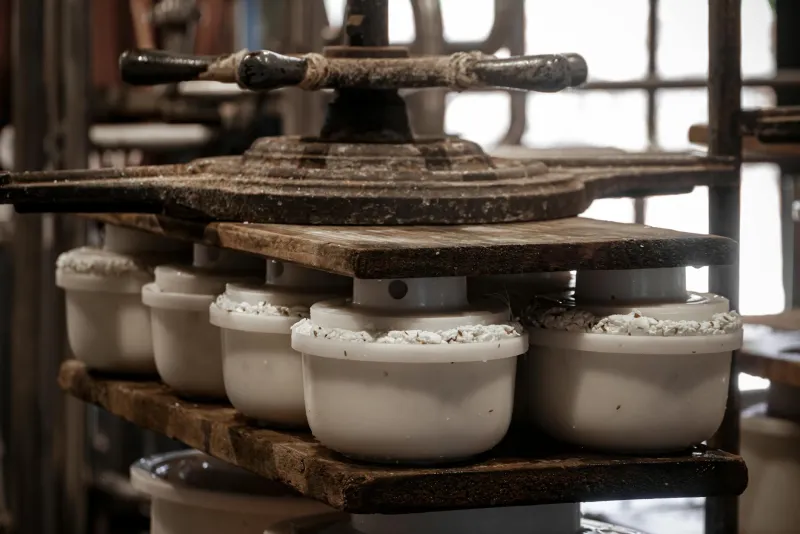
His solution was to use actual clay bricks as weights during the pressing process, which gave the cheese its flat, rectangular shape. The name stuck. So did the flavor.
Brick cheese lands somewhere between a mild cheddar and a young limburger — creamy and slightly tangy when young, developing a sharper, earthier edge as it ages. At its ripest, it gets genuinely funky in a way that made it a natural fit for the strong-flavored German and Eastern European immigrant communities that dominated the upper Midwest at the time. It became a staple at delis, on sandwiches, melted into casseroles. For a while, it was just cheese — the thing people in Wisconsin reached for without thinking twice.
How Processed Cheese Won the War
The slow death of brick cheese is really the story of what happened to American food in the 20th century.
When James Kraft patented his processed cheese product in 1916, he wasn't just selling a new food — he was selling convenience, consistency, and shelf life. Processed cheese didn't sweat in the summer. It didn't develop mold. It didn't taste different from one batch to the next. For a country that was rapidly urbanizing, refrigeration was unreliable, and supermarkets were replacing corner delis, those qualities were enormously appealing.
Brick cheese, like most traditionally made cheeses, couldn't compete on those terms. It needed careful handling. It changed with the seasons. It demanded a customer who actually wanted to taste something.
By the 1950s, the American cheese landscape had been quietly flattened. Processed products dominated the market, and regional specialties like brick cheese got squeezed into an ever-shrinking corner of the dairy case. Supermarket chains, preferring to stock nationally distributed brands, stopped carrying it altogether in most parts of the country. Outside of Wisconsin — and even within parts of Wisconsin — it simply disappeared.
The Handful of People Keeping It Alive
Here's the part of the story that gives you a little hope.
A few small Wisconsin producers never stopped making brick cheese, and lately, some of them are seeing renewed interest from people who stumbled across the name and got curious.
Chalet Cheese Co-op in Monroe, Wisconsin — one of the oldest cheesemaking cooperatives in the country — still produces brick cheese using methods that would be recognizable to John Jossi. Widmer's Cheese Cellars in Theresa, Wisconsin, which has been family-run since 1922, makes a version that's aged longer than most, developing that funky, almost meaty depth that made the cheese famous in the first place. A handful of artisan producers have started including it in specialty cheese boxes and farmers' market spreads, often to the surprise of customers who assumed they'd tried every American cheese there was.
The craft cheese movement, which has exploded over the past decade, has been quietly good for forgotten regional varieties like this one. Consumers who will happily pay twelve dollars for a small wedge of something unusual are exactly the audience brick cheese needs.
Why You Should Actually Try to Find Some
Beyond the historical footnote, there's a real argument for seeking brick cheese out.
It melts beautifully — arguably better than cheddar — which makes it exceptional for grilled cheese, pizza, and those Midwestern hot dishes that deserve better cheese than they usually get. Young brick is mild enough to appeal to people who find aged cheeses overwhelming. And the older, more pungent versions offer a flavor experience that's genuinely hard to find in the American market without spending serious money on imported European cheeses.
More than that, there's something worth preserving about a food with a real American origin story — one that didn't come from a factory formula or a marketing team, but from a Swiss immigrant pressing curds with bricks in a Wisconsin dairy barn.
John Jossi didn't get a patent. He didn't build a company. He just made something good, and for a while, that was enough.
The least we can do is remember what it tastes like.